Soldiers of the 4th Infantry Division moving past the seawall and off the beachhead at Utah Beach on or after D-Day (Photo: U.S. Army Signal Corps) Some U.S. Army divisions enjoy the admiration of World War II buffs more than others. The 1st Infantry Division (The Big Red One), or the 82nd (The All American Division) and 101st (The Screaming Eagles) Airborne Division are among the stars of popular history. Today’s article is about one of the less-appreciated outfits, the 4th Infantry Division, also called the Ivy Division or the Iron Horse Division. They might be often overlooked, but they were a part of many critical battles in Europe. They were the first American troops to land on the Normandy beaches, they fought at Cherbourg (The Liberation of Cherbourg) and in the breakout from the Normandy lodgment (The Cobra Strikes), in the Hürtgen Forest (The Battle of Hürtgen Forest) and the Battle of the Bulge. They served in Vietnam, Germany, Iraq and Afghanistan, and they were used as an experimental unit several times in their history.
Formation and service in World War I
The 4th Infantry Division was established as “4th Division” on November 19, 1917, seven months after the U.S. entered World War I, Camp Greene, North Carolina. It was there that the division’s insignia of four ivy leaves was adopted. Ivy is a traditional symbol of fidelity, referring to the division’s motto “Steadfast and Loyal,” but it’s also a subtle pun: “IV,” pronounced “i-vee,” is the Roman numeral for “4,” which is both the division’s number and the number of leaves on the insignia. The insignia of the division (Photo: Wikipedia) The division sailed to Europe between April and June 1918. It became the only American force to fight alongside both British and French forces in their respective sectors, and also with all corps in the American sector. The division stayed in Germany as an occupation force after the war, returning to America in 1919.
The division was greatly downsized and inactivated during the peace years. It was assigned to the IV Corps, which became the divisions “active associate”: in case of war, the corps was to provide the core cadre around which the division was to be reorganized.
Preparation for World War II
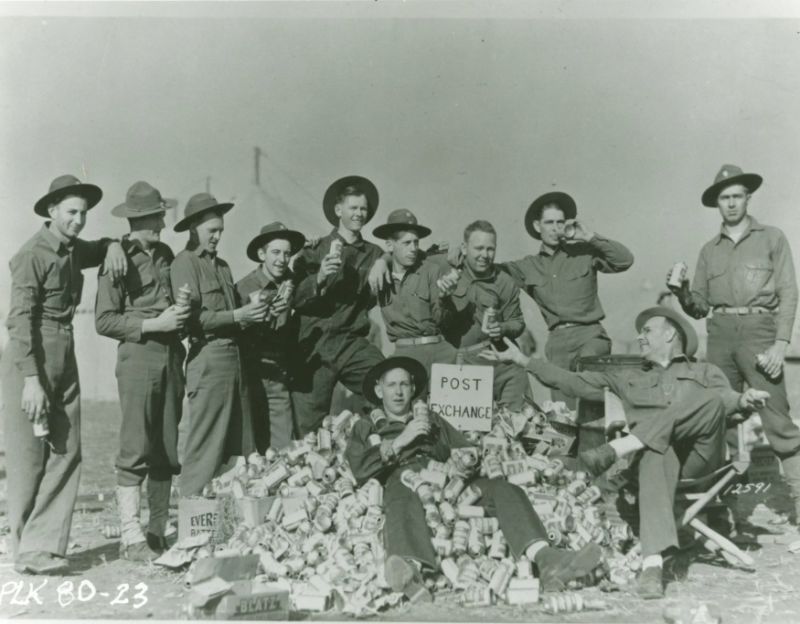
The division was reactivated at Fort Benning, Georgia, on June 1, 1940, at a time when World War II was already raging in Europe. America was still gearing up for war, and the preparations included experimentation and a thorough examination of current warfighting capability. The shockingly rapid German advances enabled by “Blitzkrieg” methodology highlighted the need for highly mobile infantry that can keep up with tanks as they break through enemy lines. The 4th Division temporarily became an experimental Motorized Division to learn how to provide such mobility. At first, the division had to borrow trucks and even take some from salvage dumps, as not enough half-tracks (The American Half-track) were available. The division participated in the massive Louisiana Maneuvers of August-September 1941, which involved 400,000 soldiers and was designed to test the quality of U.S. training, logistics, doctrine and commanders. Soldiers relaxing with “a couple of” beers during downtime in the Louisiana Maneuvers (Photo: Fort Polk Museum) In July 1942, with America already having entered World War II, the division was suddenly withdrawn from the Carolina Maneuvers for overseas deployment. This was the first of several such false alarms, and the division was eventually shipped to England only in January 1944. The Motorized Division experiment had been abandoned by this time, and the division had been reorganized as a standard infantry division.
Division commander Major General Barton
The division’s commander during the war was Major General Raymond “Tubby” Barton. Barton quickly turned out to be an iron-handed disciplinarian, who outlined his attitude in his first speech to his officers and men on the day he assumed command: “I am your leader…. In the not-too-distant future, we will be in battle. When bullets start flying, your minds will freeze, and you will act according to habit. In order that you develop the right habits, training discipline must be strict. I know that 90 percent of you want to cooperate. I will take care of the other 10 percent.” His strictness instilled a discipline in his untried soldiers that would serve them well in the trial to come. The famous author Ernest Hemingway (The Old Man and War) had accompanied the division in Europe as a war correspondent, befriended Barton, and once wrote to him “You had one of the greatest divisions in American military history.” Major General Barton (at the wheel) talking to Colonel Lanham, whose regiment became the first to break through the Siegfried Line (Photo: U.S. Army)
Preparation for D-Day
Once in England, the division participated in more exercises and the preparation for the Normandy landings. Interestingly, the division captured its first prisoner of war at this time, well before they had actually ever gone into combat: a German airman was shot down over the division’s assembly area, and was promptly apprehended.
The division also suffered its first mass casualties before the landings. In April 1944, the division participated in Exercise Tiger (Exercise Tiger), a rehearsal of the Utah Beach landing. On April 27, a timing error caused a live artillery barrage, intended to hit the beach just before the troops landed, to land right on top of the men wading ashore; survivors trying to flee the area wandered into sectors where the “defenders” were spraying the beach with live machine gun fire to make the exercise more realistic. On the following day, six German E-boats (fast attack craft) stumbled on the fleet of troop carriers participating in another landing exercise and torpedoed several vessels. The two incidents had a tally of 749 deaths and some 200 wounded. U.S. soldiers landing at Slapton Sands, the site of the deadly accident, as part of the rehearsal exercises (Photo: U.S. Army Signal Corps)
D-Day and combat in France
On D-Day, the 4th Division landed on Utah Beach as part of VII Corps, which was commanded by Major General J. Lawton Collins (General “Lightning” Joe Collins). They ended up suffering far lower casualties (197 men) than during the rehearsal. The first wave of landing craft was carried off course by the current and landed in the wrong spot. They were accompanied by Brigadier General Theodore Roosevelt, Jr., (Theodore “Teddy” Roosevelt, Jr.) who insisted on going with the first wave. After personally scouting out the area, Roosevelt decided that it was a better location than the one originally planned, and had later waves redirected to it with the declaration “We'll start the war from right here!” The statue of Theodore Roosevelt, Jr. in Normandy (Photo: Author’s own) After the successful landings, the division headed inland and relieved the 82nd Airborne Division that was isolated at Sainte-Mère-Église (Paratroopers on the Church). It then fought its way up the Cotentin Peninsula and liberated the city of Cherbourg, a deep sea port the Allies needed to land supplies, in heavy fighting. (The Liberation of Cherbourg) The division then turned east and participated in the liberation of Paris (The Liberation of Paris), though they did not participate in the victory march, as they were ordered to puh on and exploit the breakthrough. Parisians welcoming soldiers of Ivy Division during the liberation of the city (Photo: U.S. Army)
The division’s service near the German border and in the Battle of the Bulge
The division reached the Siegfried Line, Germany’s western defensive line, in September, and a patrol from the Ivy Division became the first allied infantry unit to step on German soil. German defenses, however, were too strong, and no breakthrough could be achieved at the time. The Allies had to dig in, establish a stable front, and wait for more forces. In early November, the division headed north and participated in the bloody fighting for Hürtgen Forest near Aachen. (The Battle of Hürtgen Forest) A dense forest with no proper road network denied the Allies the use of tanks or tank destroyers, while infantry was exposed to German air-burst shells raining shrapnel and murderous wooden splinters on them from above. Units suffered appalling casualties, and food, ammunition and the wounded were often carried by hand for lack of other conveyance. In the end, grit and perseverance won out, and the 4th Division emerged on the far side of the forest.
The division reached the city of Luxembourg on December 12, and settled in for rest, supplies, and the wait for reinforcements over what was believed to be a quiet sector. Unknown to the Allies, however, Germany was preparing for its last great counteroffensive on the Western Front, through the Ardennes Forest. The attack began at dawn on December 16. Several Allied divisions were overrun in the north, and the southern shoulder of the German drive fell right into the Ivy Division’s sector. Exhausted from the fighting in the Hürtgen Forest, and low on men and supplies, the division was put to a dire test. Cooks, military police, mechanics and whatever men could be pulled together were put on the frontline to repel German forces. It proved sufficient. Luxembourg was saved, and American units behind the frontline were given time to reorganize for a counterattack. After the battle, Lieutenant General Patton (The Wars of George S. Patton) wrote to Major General Barton on his command of the division: "So far as l know, no American division in France has excelled the magnificent record of the 4th Infantry Division, which has been almost continuously in action since it fought its way ashore on the 6th day of last June. Your fight in the Hurtgen Forest was an epic of stark infantry combat; but, in my opinion, your most recent fight—from the 16th to the 26th of December—when, with a depleted and tired division, you halted the left shoulder of the German thrust into the American lines and saved the City of Luxembourg, and the tremendous supply establishments and road nets in the vicinity, is the most outstanding accomplishment of yourself and your division." Two signalmen of the 4th Division hunting to supplement their rations during the Battle of the Bulge (Photo: U.S. Army Signal Corps) The 4th Division finally crossed the Rhine into Germany in March 1945, and pushed forward with lightning speed, reaching the vicinity of the Austrian border by May 1945, when the war ended in Europe. The division returned to America in the summer and started preparing for deployment to the Pacific, but the Japanese surrender (The Jewel Voice Broadcast)made that unnecessary. The division was deactivated in 1946 and then reactivated as a training division the following year. Soldiers of the 12th Regiment, 4th Infantry Division boarding their ship home (Photo: U.S. Army)
The early Cold War
Meanwhile, the Cold War had begun, and Europe became a potential battlefield once more. The 4th Infantry Division was redesignated as a combat division and deployed to West Germany for a five-year mission starting in 1951 to deter Soviet aggression. Once the deployment was over, the division was reduced to zero strength and the name and flag transferred to the 71st Infantry Division.
The “new” 4th Division was reorganized in 1957 as part of the Army’s experiment with Pentomic Divisions. The Pentomic Division was an organizational scheme designed by Army Chief of Staff Maxwell D. Taylor (“The last of the World War II heroic generals”) during President Eisenhower’s (The Supreme Commander – Part I) (Part II) presidency in response to the new threat of tactical nuclear weapons. The idea was that by dividing a division into five smaller “battle groups” instead of three larger regiments, only a fifth of the division, rather than a third, could be destroyed by a single nuclear strike. The experiment didn’t pan out very well, and the division was reorganized again in 1963 to a new army-wide scheme of three brigades to a division.
Vietnam and return to Europe
The division served in Vietnam from 1966 to 1970, fighting in the Central Highlands region. They acted as the first line of defense against North Vietnamese infiltration attempts down the Ho Chi Minh Trail through Laos and Cambodia, protecting the more populated lowlands. It saw intense combat against both the North Vietnamese regular army and the Viet Cong while guarding a larger area of operations than any other division in the country; the division also conducted cross-border operation during the incursion into Cambodia. 4th Infantry Division soldiers approaching a hut in Vietnam (Photo: U.S. Army) After the Vietnam War, the division was reorganized once again, this time into a mechanized infantry division, and sent constituent units to the annual REFORGER (“REturn of FORces to GERmany”) exercises which practiced rapid deployment to Europe in case of a Soviet attack and the beginning of World War III. It was during this time that the division adopted the alternative nickname “Iron Horse” to highlight its speed and power. The division was deactivated in 1984.
Modernization and the division’s history in the 21st century
The 4th Infantry Division (Mechanized) was reactivated in 1995 and was designated EXFOR, “Experimental Force,” for the U.S. Army’s Force XXI modernization program. The division became a test bed for state-of-the art communications equipment, night fighting gear, advanced weaponry, and new organizational and doctrinal schemes aimed at preparing the Army for the challenges of the new century.
In 2003, the division was slated to participate in the invasion of Iraq as a spearhead force advancing into the country from Turkey. The Turkish parliament refused U.S. troops to launch an invasion from Turkey’s territory, and the division eventually acted as a follow-up force launching from Kuwait. During its advance, the division realized that the lead elements of the invasion force were critically low on resources, putting the invasion at risk of stalling. The division distributed some of its own supplies among the other divisions and continued the drive north alone. Elements of the division later cooperated with special forces in the capture of Saddam Hussein. A soldier of the division in Iraq (Photo: Tech. Sgt. Dawn M. Price, U.S. Air Force)The division also fought in Afghanistan from 2009 onward. 4th Brigade Combat Team was deployed to the Arghandab River Valley in Southern Afghanistan, an area known as the “Heart of Darkness” for being the birthplace of the Taliban and an extraordinarily difficult area to fight in.The 4th Infantry Division has a proud history of over 100 years in service of the United States of America from World War I to the conflicts of the present day. The division’s 20 Medal of Honor recipients (The Medal of Honor) stand as testimony to the unit’s motto, Steadfast and Loyal.