Beaches of
NormandyTours
NormandyTours

Few generals in American military history are surrounded by as much controversy as William Westmoreland, who led the U.S. war effort in Vietnam from 1964 to 1968. The Vietnam War itself, the mistakes made there, the exact causes of ultimate defeat, and what (if anything) could have been done to reach a different conclusion, are the subjects of debate to this day. This article focuses on the brief biography of General William Childs Westmoreland (1914-2005), one of the key figures in the drama that unfolded in Vietnam.
Westmoreland was born in Spartanburg, South Carolina, to an upper middle class family involved in banking and the textile industry. He was a true golden child, an Eagle Scout who was given both the Distinguished Eagle Scout Award and the Silver Buffalo. Choosing a military career, he spent one year at The Citadel, the military college in South Carolina, but was then appointed to attend West Point on the nomination of a family friend, Senator James F. Byrnes, a friend of F. D. Roosevelt who would later head the Office of War Mobilization and provide oversight, material and money for the Manhattan Project. Westmoreland later said he enrolled at West Point to “see the world.”
Westmoreland was classmates with Benjamin O. Davis Jr., who would go on to command the Tuskegee Airmen in World War II, and Creighton Abrams, who would succeed him at his post in Vietnam. He graduated in 1936 at the rank of First Captain, the highest cadet rank, and, as the cadet with the highest level of military proficiency, was presented with the Pershing Sword. (The General of the Armies)

Westmoreland had a promising career before him, but he might have received just a bit too much support from home. His father once wrote him a letter, saying “The people here, white and black, think you are about the biggest man in the country. Roosevelt has no rank at all compared to you. They really believe you will be president of the US someday and talk this among themselves.” While parental support is important, one wonders if this much adulation might have given him ideas that influenced his later decisions poorly.
Westmoreland served with distinction as an artillery officer during World War II, beginning the war as a battery commander. He saw action in Tunisia, where he took part in the Battle of Kasserine Pass (The Battle of Kasserine Pass) and helped prevent a German breakthrough after U.S. forces were caught unprepared for the battle. In Sicily, he became the artillery commander of the 82nd “All American” Airborne Division (The All American Division), where the chief of staff was General Maxwell Taylor (The Last of the World War II Heroic Generals). He landed with the 9th Infantry Division in Normandy four days after D-Day . His strong performance in France was noted by division commander James Gavin. (James M. Gaving, the “Jumping General”) He went on to serve in France and Germany as a staff officer, and was appointed chief of staff of the 9th Infantry Division in October 1944.
After returning to the U.S., Westmoreland completed paratrooper jump school in 1946 and was appoint commander of the 504th Parachute Infantry Regiment, 82nd Airborne Division. He served as chief of staff of the division from 1947 to 1950.
Westmoreland commanded the 187th Airborne Combat Team in the Korean War in 1952 and ’53. He was promoted to brigadier general in November 1952, becoming one of the youngest U.S. Army generals since the end of World War II. The 187th was stationed in Japan as theater reserve, and was periodically deployed to Korea. During one such stint, Westmoreland made 13 parachute jumps in a single day to qualify for the Master Parachutist Badge.
On his return to America in late 1953, Westmoreland was given a desk job at the Pentagon as deputy chief of staff, G-1 (personnel). While there, he also completed a 3-month management program at Harvard Business School; one wonders if the lessons he took from there ended up making so receptive to Secretary of Defense Robert McNamara’s obsession with quantifiable figures during the Vietnam War.

Westmoreland hated his position, and was rescued by his former superior, Maxwell Taylor, who was Army Chief of Staff at the time and made him Secretary of the General Staff. Westmoreland went on to command Taylor’s old World War II outfit, the 101st Airborne Division (The Screaming Eagles), from 1958 to 1960.
Some historians claim that Westmoreland’s time with the 101st was the high point in his career. He was a popular commander whose men considered him a great general. He deeply cared about the well-being of his men, and used to go around the bars frequented by them to convince them to drink beer at their posts rather than risk getting into a drunk driving accident on the way back to base. It appears that the range of his responsibilities, the intellectual requirements of the job, the high degree of physical activity and close contact with his men were just right for his own capabilities. It’s too bad he went on to positions of greater responsibility.

Westmoreland was superintendent at West Point from 1960 to 1963. This was a highly unusual appointment, as he had pursued no higher military education after graduating there, except for jump school after the war and a one-month course in mess management at the Cooks and Bakers School at Hawaii as a lieutenant. He never attended the General Staff College at Fort Leavenworth, the Army War College at Carlisle Barracks, or any other similar institution. In fact, he had never even been an instructor at West Point. According to one anecdote, he had Sun Tzu’s famous The Art of War on his bedside table, but his advisors suspected he never took it off the table to read it.
While the appointment seems like a strange decision, we should be fair to Westmoreland and acknowledge that he ignored the academic matters he knew he didn’t have the background for, and focused on administrative and logistics issues instead, doing pretty well in those. Sometime after he left West Point, an officer sent him a note that his picture was still hanging on the wall in West Point’ printing plant, as he was the only superintendent to ever visit or take the slightest interest in the facility.

Westmoreland had a half-year stint as commander of the XVIII Airborne Corps, but his greatest test – and failure – came afterwards. He was sent to South Vietnam in January 1964 as the new deputy commander of Military Assistance Command, Vietnam (MACV), and was appointed commander on August 1, one day before the Gulf of Tonkin incident.
A more detailed description of the course of the Vietnam War and the decision made by American leadership might be a topic for future articles, but we will give a brief overview of Westmoreland’s role here. During his stay from 1964 to 1968, his overarching strategy was to strike at North Vietnamese forces with large units (the so-called “big battalions”) wherever they could be found. Westmoreland’s war revolved around “search and destroy” missions performed primarily by U.S. forces, and he neglected upgrading the equipment of the Army of the Republic of Vietnam (ARVN, the army of “South Vietnam”). This latter long prevented the ARVN to make significant contributions, as they were still partially stuck with World War II-era weaponry such as the M1 Garand (The M1 Garand Rifle), the Thompson submachine gun (The Thompson Submachine Gun), the BAR (The Browning Automatic Rifle), the Bazooka (The Bazooka) and the M3 Half-track (The American Half-Track), while the Northern forces were supplied with AK-47s and other modern equipment by China and the Soviet Union. Westmoreland also put little emphasis on securing the South Vietnamese countryside and preventing the Viet Cong guerillas from controlling the villages through coercion and terror. Westmoreland was fighting a war of attrition: he, along with Washington leadership, believed that once enough North Vietnamese soldiers and Viet Cong were dead, they would give up.

That never happened. North Vietnamese forces quickly learned that they cannot beat American troops in open combat. Instead, they would retreat into the jungle or take shelter in sanctuaries established in neighboring Laos and Cambodia; U.S. forces were forbidden from crossing the border and taking the fight to these sanctuaries, or interdict the Ho Chi Minh Trail during Westmoreland’s tenure, as American political leadership did not want to risk an escalation. Similarly, an invasion of or air strikes against North Vietnam itself were also off the table due to political considerations during this period.
Now, some historians claim Westmoreland was not blind to how the Viet Cong had free run of the southern countryside, he was just not in a position to do much about it. Based on some sources, his plan might have been for U.S. forces to stop the regular North Vietnamese army, which he felt was the more urgent threat, from advancing into South Vietnam, while the ARVN would pacify the villages and take care of the Viet Cong – only this second part never happened.

Be that as it may, what’s certain is that the strategy executed by Westmoreland was clearly not working. More and more American troops were being sent to Vietnam with no real progress to show for it. Westmoreland kept making rosy speeches about how victory was within reach. Secretary of Defense Robert MacNamara, who was asking for numbers to show the war was going the right way, was getting encouragingly high body counts of dead North Vietnamese soldiers and decreasing estimates of remaining North Vietnamese strength.
The problem was that those numbers were fake. Westmoreland gave orders to provide artificially deflated numbers for enemy troops, forbidding the CIA to publish a number higher than 399,000, while the truth was over 600,000 – he didn’t want the public to know just how strong the enemy was. Kill statistics were also interfered with. Officers knew that their promotions depended on reporting high kill figures, so they went and provided those figures, often by shooting all civilians in “free fire zones” or for undefined “suspicious behavior” and reporting them as Viet Cong casualties. And if that wasn’t enough, numbers were just flat-out made up. Regardless of Westmoreland’s strategy or the political limitations he had to work within, knowingly falsifying reports he was passing up to Washington was not excusable.

The difference between Westmoreland’s strategy and the demands of the American public were highlighted during a visit to Vietnam by Senator Hollings from Westmoreland’s home state of South Carolina. Westmoreland bragged to him: “We’re killing these people at a ratio of ten to one.” The Senator’s reply was “Westy, the American people don’t care about the ten, they care about the one.”
Westmoreland’s fall from grace came in the aftermath of the Tet Offensive in early 1968. The offensive was a massive Northern surprise offensive in large part out of Laos and Cambodia, against all of South Vietnam. Militarily speaking, the offensive was a Northern failure: they suffered heavy casualties and were eventually beaten back in fierce fighting. Politically, however, America suffered the biggest loss. What the American public saw on TV was not the eventual victory. It was the heavy fighting in areas that were supposed to be safe, including the Southern capital city of Saigon itself, and the death of thousands of U.S. servicemen. Westmoreland’s and the political leadership’s claims of imminent victory were revealed to be lies.

Patience with Westmoreland ran out, especially after the White House learned he was considering the use of nuclear weapons. News of the My Lai Massacre were another blow to popular support of the war, even though, to be fair, Westmoreland resisted pressure for a cover-up.
Westmoreland had to be removed from the chess board, but he ended up falling upwards: he was appointed Army Chief of Staff in June 1968, and succeeded at the head of MACV by Creighton Abrams, who quickly switched focus to pacification and anti-insurgency (though it was too little too late by then).

The Army was facing a series of problems: indiscipline, drug abuse, racial tensions, budgetary shortfalls and the challenges of preparing to transition to an all-volunteer force. Instead of focusing on these, Westmoreland decided to act as a spokesman for the military, defending mistakes in and claiming the army was doing everything right. A comprehensive study on the deterioration of officer behavior was published during his tenure. He made some policy changes in response, but also kept the report out of the public eye.
Westmoreland retired in 1972 despite being offered the position of Supreme Allied Commander in Europe. He unsuccessfully ran for Governor of South Carolina in 1974. In 1982, he unsuccessfully sued CBS after the network broadcast a documentary on how North Vietnamese troops strength was deliberately underreported under his command. He never admitted to any wrongdoing or mistakes, defending his decisions in Vietnam for the rest of his life. He died in 2005 after years of struggling with Alzheimer’s Disease. He is buried at West Point Cemetery in a plot he picked while superintendent there.
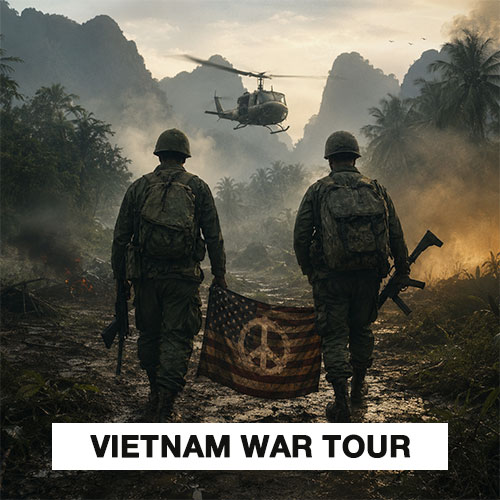
Join us on our Vietnam War Tour to learn more about the war and see how Westmoreland led the American forces during his tenure between 1964-68.





Beaches of Normandy Tours
Beaches of Normandy Tours SAS, Normandy, France
Band of Brothers Tours
Band of Brothers Tours FZCO, Dubai, UAE