Beaches of
NormandyTours
NormandyTours
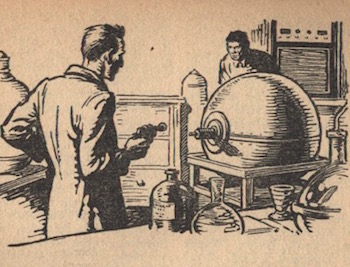
Cleve Cartmill is not a very well-known name in science fiction literature today. A pulp author as well as a journalist, accountant and radio operator, he is remembered as a competent but undistinguished writer. His claim to fame came in the spring of 1944, when his short story Deadline managed to attract the attention of the FBI.
Deadline, a “stinker” by Cartmill’s own admission, was published in the magazine Astounding Science Fiction. It is set on an alien planet where two alliances, the Sellia and the Sixa (read them backwards) are fighting a global war. (The nations in the alliances are Acireb, Aissu, Ynamre and Ytal – again, read them backwards, adding and changing a few letters.) The protagonist is a Sellia agent sent to kill a Germ… we mean Ymanre scientist and sabotage the super-bomb he was working on, a desperation weapon (the “Sixa” are losing the war) which might malfunction and destroy the world.
It would be a dime-a-dozen pulp yarn, were it not for one detail: the superweapon is an atomic bomb, not unlikely the one being developed by Manhattan Project in utmost secrecy. While much of the science in the story was wrong, a lot of it about the bomb’s construction, the operating principle, and the use of Uranium-235 was also discomfortingly close to the real-life details of the top-secret Manhattan Project. Even the possibility of an unwanted and globally destructive runaway chain reaction, a major plot point, was something floated by Edward Teller while developing the real bombs.
“Two cast-iron hemispheres, clamped over the orange segments of cadmium alloy. And the fuse–I see it is in–a tiny can of cadmium in a beryllium holder and a small explosive powerful enough to shatter the cadmium walls. Then–correct me if I’m wrong, will you?–the powdered uranium oxide runs together in the central cavity. The radium shoots neutrons into this mass–and the U-235 takes over from there. Right?”
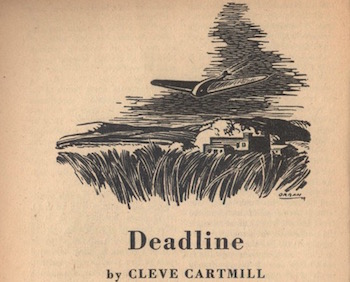
Passages like this were read by someone in Washington – and, apparently, by some of the scientists working on the bomb who had a subscription to Astounding. Cartmill and Astounding editor John W. Campbell were promptly investigated. Cartmill said that while he came up with the idea of sabotaging a super-bomb, the technical details were all suggested by Campbell. Campbell, who studied physics at MIT, claimed that all the details were logical conclusions based on publicly available science articles.
After an investigation that involved opening Cartmill’s mail and submitting both men to days of interrogation, the matter was dropped as nothing more than unsettling coincidence. The Manhattan Project’s chief of security wanted to shut Amazing Science Fiction down entirely, but the Office of Censorship refused.




Beaches of Normandy ToursBand of Brothers Tours48 Rue de Thouays, 50480 Sainte-Marie-du-Mont, Normandy, France
Phone: +1 855-473-1999Monday - Friday, 10am - 6pm ETe-mail: info@beachesofnormandy.com