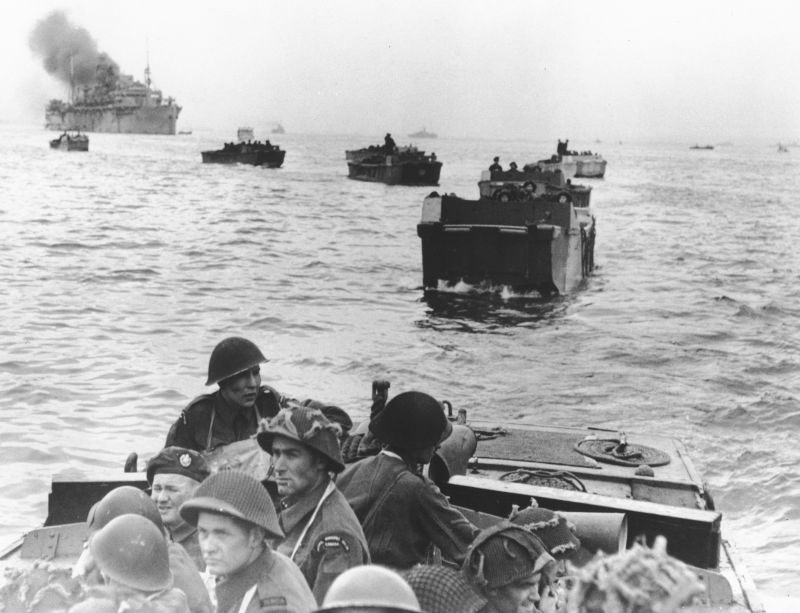
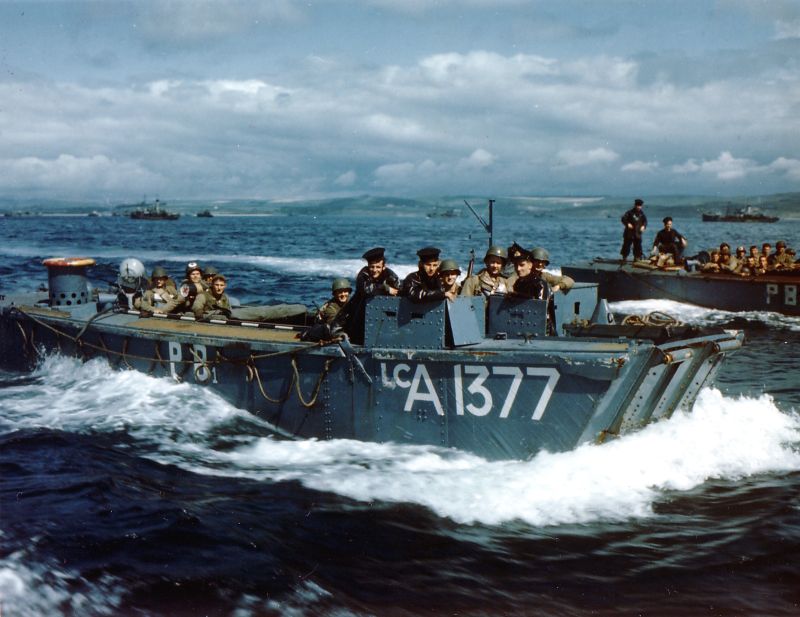
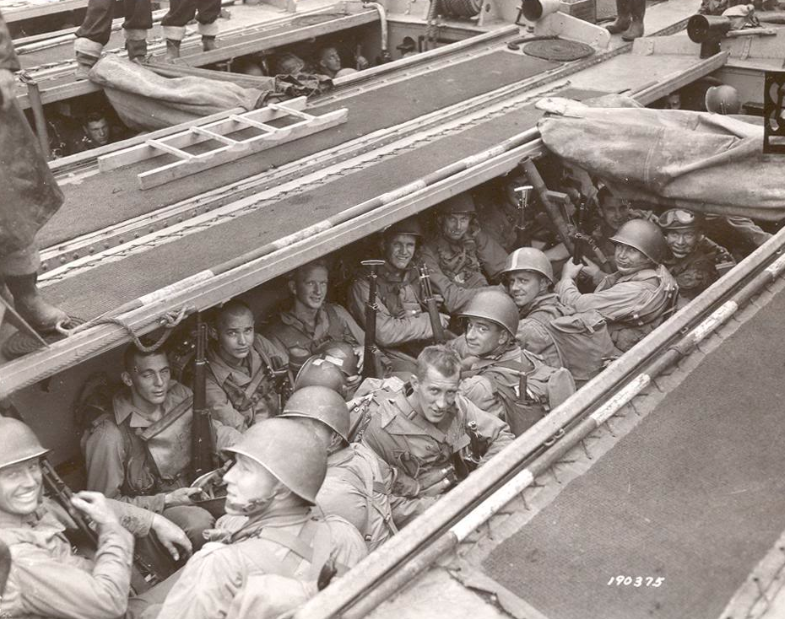
American soldiers aboard an LCA during preparations for D-Day (Photo: U.S. Army Signal Corps) The best-known landing craft of World War II is the Higgins boat (The Higgins boat), officially called "landing craft, vehicle, personnel". The LCVP, however, was only one of many designs used by the Allies to put troops, vehicles and supplies on contested shores in the Mediterranean, Normandy, and the Indian and Pacific Oceans. Another famous, though less numerous, boat that saw wide use was the British Landing Craft Assault, or LCA, a vehicle designed less for mass assaults and more for commando operations.
Inception of the LCA
Britain was a long-standing naval power, and had performed landings on enemy-held shores since at least the 18th century. Between the World Wars, British military theoreticians were very interested in developing modern amphibious assault tactics, but the post-World War I economic recession and the belief that air power would render such operations impossible prevented much actual development from occurring.
That changed with the Munich Crisis of 1938, which staved off World War II for a while, but revealed that Hitler will never be content with what he already had, and it was clear that war was on the horizon. Among many other things, modern landing craft were going to be needed. The Inter-Service Training and Development Centre (ISTDC) drew up specifications for such a boat. They wanted a vehicle that weighed less than 10 long tons (11.2 U.S. tons), could be carried on the davits (cranes) of passenger liners (since many of these would be pressed into service as troop transports), and could carry and rapidly disembark a full British Army infantry platoon of 31 men along with 5 assault engineers or signalers, getting them close enough to the shore that they would only get wet up to their knees.
The staff of the Director of Naval Construction (DNC) were busy with more immediate shipbuilding needs, so the ISTDC approached a civilian maritime architect by the name of Mr. Fleming. Mr. Fleming designed an aluminum boat to the requirementsby November 1938 and built a wooden mock-up. The DNC had some reservations and insisted that other companies should also be allowed to tender their designs. Eventually, two designs were judged: the one by Mr. Fleming, and another by the John I. Thornycroft & Company shipbuilding firm. New LCAs being delivered, most likely in 1944 (Photo: combinedops.com)
Final design
Competitive tests revealed that Fleming's design had many advantages, as it behaved admirably in the water, was faster, its silhouette and bow wave were less noticeable from a distance, and troops could disembark in quarter the time compared to the other boat. It did, however, also have drawbacks: it's rounded hull shape was difficult to make steel armor for, and its pair of 120 hp Chrysler engines were so loud they made any sort of surprise nighttime landing impossible. Thornycroft's hardwood boat was easier to armor, and its two 65 hp Ford engines were much quieter (but also much slower). In the end, the Thornycroft designed was selected for mass production. The original service name was "Assault Landing Craft," which was later changed to "Landing Craft Assault" to be in compliance with US-British joint naming standards.
The final design was 41 ft 6 in long and 10 ft across, longer but slightly narrower than the Higgins boat (36 ft 3 in by 10 ft 10 in). When loaded, its draft was 2 ft 3 in in the back, less than the Higgins boat's 3 ft. The big difference was in speed: thanks to its weak engines, the British boat's loaded speed was a stately 6.9 mph, half of the LCVP's.
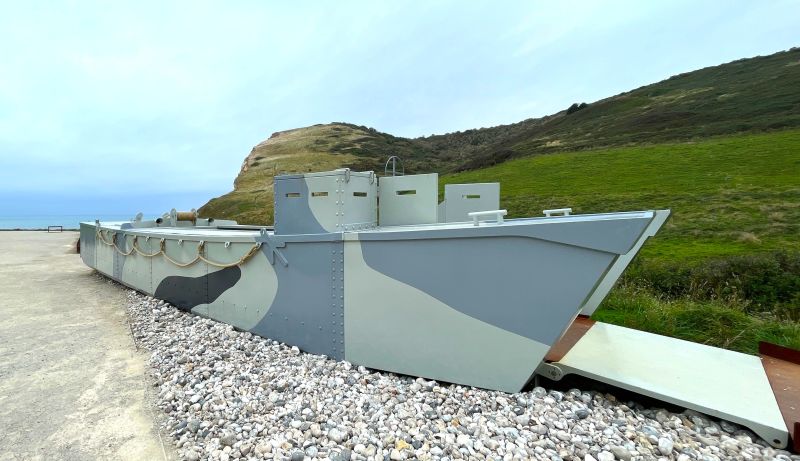
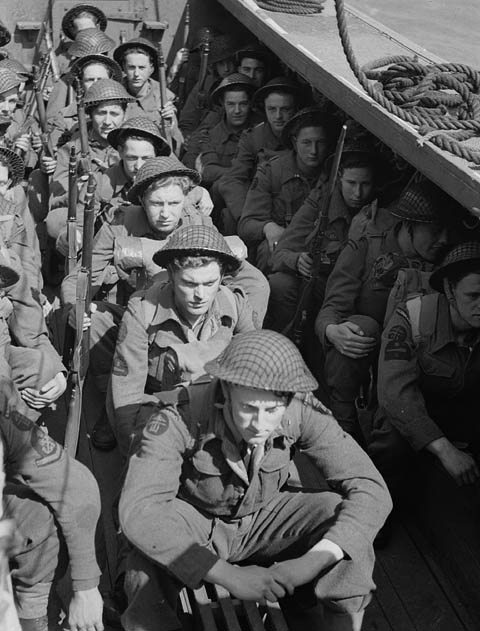
The LCA offered three benches for troops to sit on, running down the length of the central well, with the benches on the sides protected from above by the upper hull. The front had a pair of armored doors that opened outward and led to a ramp. A full contingent of troops could disembark in two to three minutes, or less with enough training. Near the front, there was the steering shelter on the starboard side and a Lewis machine gun position on port. Commandos in an LCA during an exercise. You can see the central and port columns seated on their benches. (Photo: Lt. Richard G. Arless)
Variants
The LCA was designed with an eye to modifications, since the ISTDC also wanted more heavily armed versions that could provide fire support during landings with heavy machine guns and smoke mortars. The first version of the so-called LCS(M) had a centrally located armored steering shelter and was armed with two .50 caliber machine guns, two .303 Lewis machine guns, and either one 4-inch mortar or a 20 mm gun. It had a crew of 11: the regular crew of four and seven who operated the weapons. The second version placed the two heavy machine guns in a single twin turret. Since the vehicle was not supposed to beach, the third version saw the door and ramp in the front replaced with a proper bow, improving seaworthiness. An LCS(M) support version (Photo: Imperial War Museums) Another variant was the LCA(HR), the letters standing for "Hedgerow." The Hedgerow variant carried a Hedgehog spigot mortar system in the central well, whose floor was reinforced to support the weapon and shock of its firing. The Hedgehog was originally designed to launch a cluster of 24 mortar rounds at enemy submarines. On the LCA, the weapon was used to bomb a roughly 100-yard-diameter circle on the shore 250 yards ahead of the boat. The goal wasn't to kill enemy troops, but to destroy mines and wire obstacles, allowing the troops in other boats to advance more quickly after disembarking.
Another idea was to have the LCA carry a long hose attached to a rocket. Once launched, the rocket would carry the end of the hose onto the beach. The crew would have then pumped nitroglycerine onto the beach through the hose, attached an explosive charge to the hose and thrown it into the water, then rapidly retreated before the whole thing ignited, causing a massive explosion on land. This was never put into practice. A similar experiment using a Universal Carrier on land went awry, causing a great loss of life and equipment.
Not an official variant, but a notable field modification was used by the U.S. Rangers who assaulted Pointe du Hoc on D-Day. (Pointe du Hoc) Each of the 10 LCAs carrying the force was equipped with three pairs of rocket tubes loaded with grappling hooks. Once the Ranger force reached the foot of the promontory, the grappling hooks were launched at the top, dragging up ropes, toggle ropes and rope ladders to help scale the cliff. The boats also carried extension ladders to help the troops get up. U.S. Army Rangers in an LCA on June 1, 1944 (Photo: U.S. Army) Other support varieties were also built or at least planned, but some never saw action. One of these was the LCA (FT), equipped with a flamethrower, and the LCA (CDL), armed with an extremely bright searchlight code named "Canal Defence Light," that was supposed to illuminate landing beaches at night and dazzle and disorient the defenders. (Such lights were also mounted on tanks like the M3 Grant (The M3 Medium Tank) in the British engineering unit nicknamed Hobart's Funnies (Hobart's Funnies). The least warlike variety was the aptly named LCA (Bakery), designed to provide landing troops with fresh bread on the beach.
Some 2,000 LCAs of all variants were built during the war, but not all by Thornycroft, as the company was also constructing other vessels for the war effort and their shipyards were overtaxed. In 1941, the Admiralty decided that rather than placing all orders with Thornycroft and letting them subcontract the work, they themselves would contact carpenters, cabinetmakers and yacht builders all over the country and have them build additional LCAs.
Crew and unit organization
Each LCA had a crew of four ratings. The coxswain steered the boat but did not control the engines directly. Instead, he communicated with the stoker-mechanic, who was in the engine comparment, via voicepipe and engine order telegraph (the mechanical device you often see in historical films with orders like "half," "slow," and "stop" written on a dial). The bowman-gunner operated the doors, the ramp and one or two of the machine guns. Finally, the sternsheetsman was located in the back and assisted with lowering and raising the boat off and onto the davits of the infantry landing ship carrying it. Every group of three LCAs was commanded by a junior officer who himself was aboard one of them, and communicated with the other vessels via signal flags, radio, or signal lamps and loudhailers, which could sometime be more reliable than the radio sets.
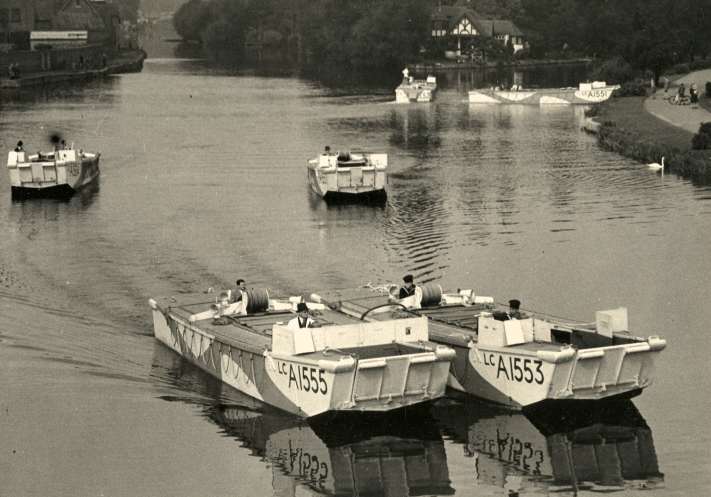
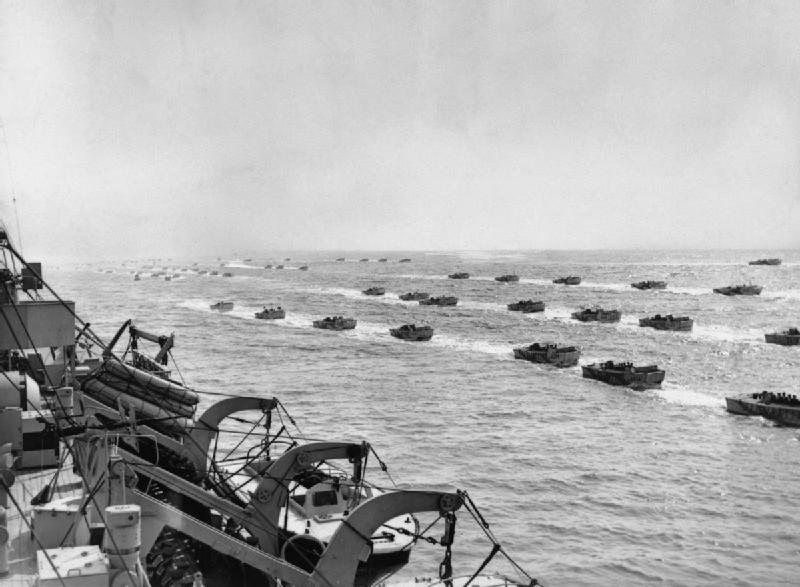
A flotilla of LCAs normally comprised 12 boats, capable of carrying two infantry companies at the same time. This could be changed depending on the requirements of an operation or the size of the infantry landing ship the flotilla was carried on. A fleet of LCAs passing a ship carrying King George VI (Photo: John Alfred Hampton) The quietness of the LCA (when moving at slow speed, it could not be heard from 25 yards away), its relatively low silhouette and its small bow waves made it ideal for commando operations. In fact, the LCA unit structure ended up affecting commando organization. In early 1941, commando units were set up so that each unit consisted of a headquarters and six troops, each troop being three officers and 62 other ranks. This was specifically done so that one troop could fit in two LCAs.
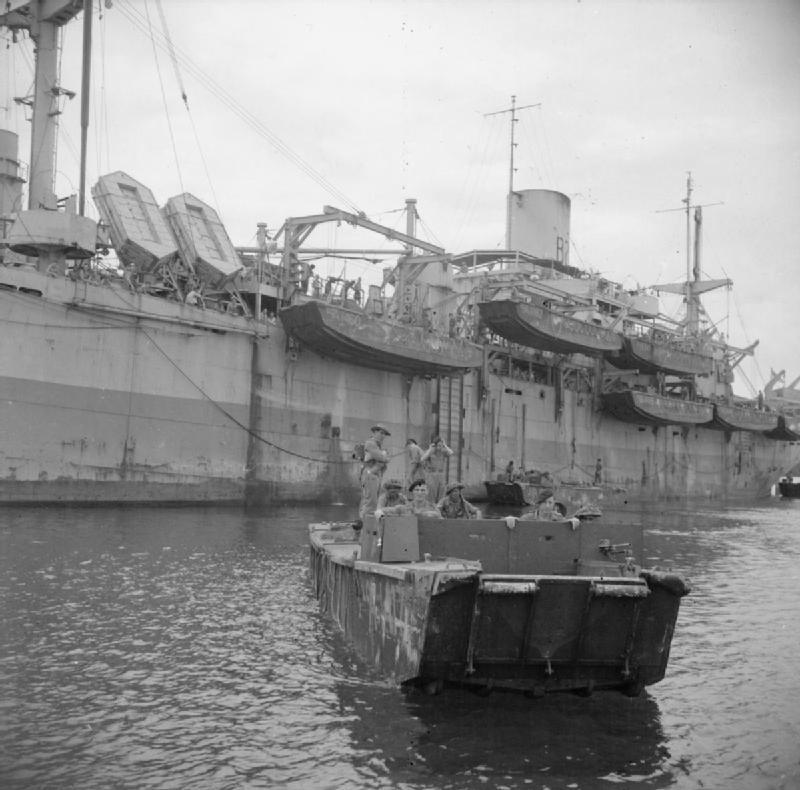
LCA crews came from several branches of the military. Most were Royal Navy or Royal Marines personnel, but there was also a smaller number of Royal Canadian Navy men, and men from the Royal Indian Navy. Even men from the Indian Army were pressed into service as crewmen, but most of them had never been to sea before and their training suffered from a lack of boats, spare parts and trained instructors. An LCA departing from a landing ship, with other boats still hanging from the davits in the background (Photo: Imperial War Museums) One constant difficulty in crewing the boats was that once an operation wound down, the experienced crewmen were sent to other units in the Royal Navy. When the next operation came up, those men were thus unavailable, and new, inexperienced crewmen had to be trained for the purpose.
Service history
LCAs were first used in combat on May 13, 1940, during the Norwegian Campaign in which Allied forces to help Norway repel the German invasion. (The German Invasion of Norway) Four LCAs dropped 120 French Foreign Legionnaires behind German lines near Narvik, forcing the Germans to give up their positions.
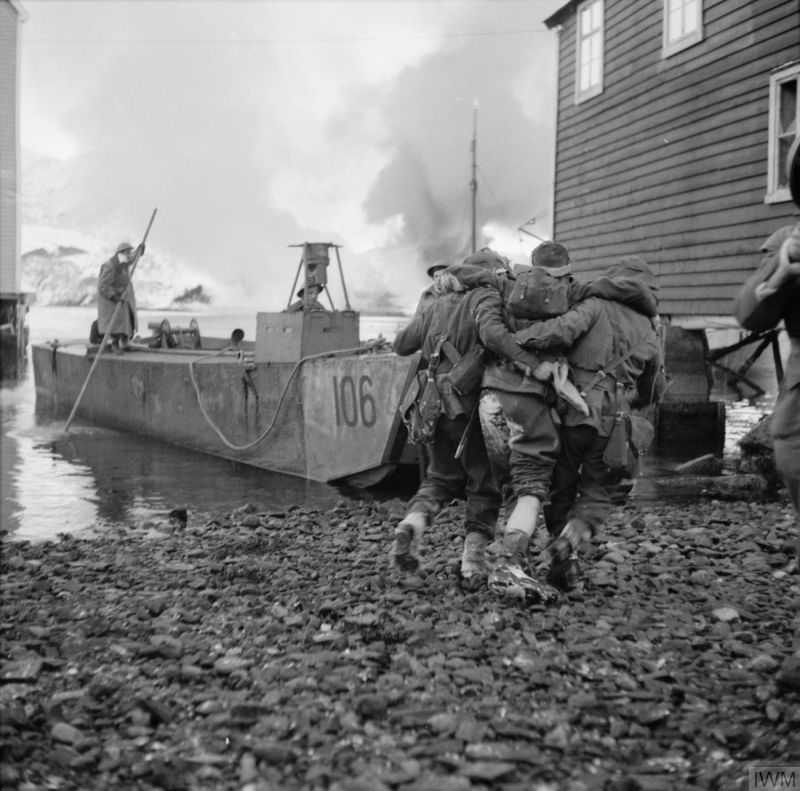
13 LCAs were used two weeks later, during the Dunkirk Evacuation (The "Miracle of Dunkirk"). Five were lost when the ship carrying them was bombed and sunk, and another one was stranded on the beach and set afire to prevent use by the enemy. From 1941 onward, LCAs served in numerous commando operations in Norway and the Mediterranean. A wounded soldier being helped back to his LCA during a commando raid in Norway (Photo: Imperial War Museums) In February 1942, they participated in Operation Biting(The Bruneval Raid), the mission to steal a German Würzburg radar set from Normandy. They were not used to land troops on this mission, only to pick up the paratroopers who jumped into the area earlier during the night. These boats had sandbags laid across their decks, used as parapets for Bren guns and Boys anti-tank rifles that covered the retreating commandos. The same year also saw LCAs used in several operations during the battle to capture the Vichy French colony of Madagascar off the east coast of Africa. An LCA in Madagascar (Photo: Imperial War Museums) On August 19, 1942, 60 LCAs, a larger force than ever assembled before, took part in the disastrous Dieppe Raid. (The Dieppe Raid) 33 of the 60 boats were lost in the operation, 17 of them support fire varieties. The results prodded British war planners to establish permanent assault groups of LCAs. One such group, comprising survivor boats from the raid, was named Force J (for "Jubilee," the raid's operation name), and ferried Canadian troops once again on D-Day, to Juno Beach. LCAs were also used in Operation Torch, the landings in North Africa, and Operation Husky, the Sicily landings.
In 1943 in Burma, a tiny flotilla of two LCS(M)-s and two motor launches forced their way past the Japanese and up the Mayu River. There they spent two and a half months harassing the Japanese, evading patrol at day and hitting outposts and supply craft at night. One LCS was sunk in combat; the other three vessels were eventually forced so far upriver by the overwhelming Japanese force that the water became too shallow for them to navigate. The two launches were destroyed by their crews, and the LCM was left on a mud bank to be claimed by a jungle; the crews had to find their way back to British lines on foot.
On D-Day, LCAs were used on all five landing beaches (and, as mentioned above, also carried Rangers to Pointe du Hoc). U.S. forces used them to secure the flanks of Omaha Beach and the westernmost end of Utah Beach. Later in the year, French and U.S.-Canadian commando units used LCAs to quietly approach and disable German artillery position during Operation Dragoon (Operation Dragoon), the landings in Southern France. Canadian troops landing on Juno Beach with LCAs on D-Day (Photo: Library and Archives Canada) Most LCAs were moved to the Pacific in anticipation of the invasion of Japan, but some were left in Europe and used in the battle for control of the Scheldt River estuary in the Netherlands. The protection of the armored vessels came handy in the operation, but the boats' slow engines struggled against the river's strong current.
The LCA after the war
Some 1,500 LCAs survived the war in serviceable condition, but many were sunk, as it was cheaper and easier to discard them than to fix them up and get them back to Britain. Nevertheless, some boats found a new civilian life. They became popular with coastal holiday-makers and canal boating enthusiasts, and were also used as houseboats with their ramp sealed up and their hold covered. 22 LCAs were sold to the Royal Netherlands Navy, but British stocks of Military LCAs dwindled rapidly after the war.
20 British LCAs made a brief comeback during the Suez Crisis of 1956, when they landed commandos at Port Said. France also used 26 LCAs, decked out with a variety of guns, in their eventually doomed attempt to reestablish colonial control in Indochina after the war. This was the last recorded combat service of the vessel – poetic, considering how French troops were the first to use them in 1940. An LCA on the site of the Bruneval Raid in Normandy (Photo: NormandyBunkers.com) The LCA is a great example of how Britain could materially contribute to the Allied war effort despite having a much smaller industrial base than the United States. If you would like to learn more about Britain's unique contributions, you can do so on our Britain at War Tour!

_IWM.jpg)
.jpg)